May 6th, 2026
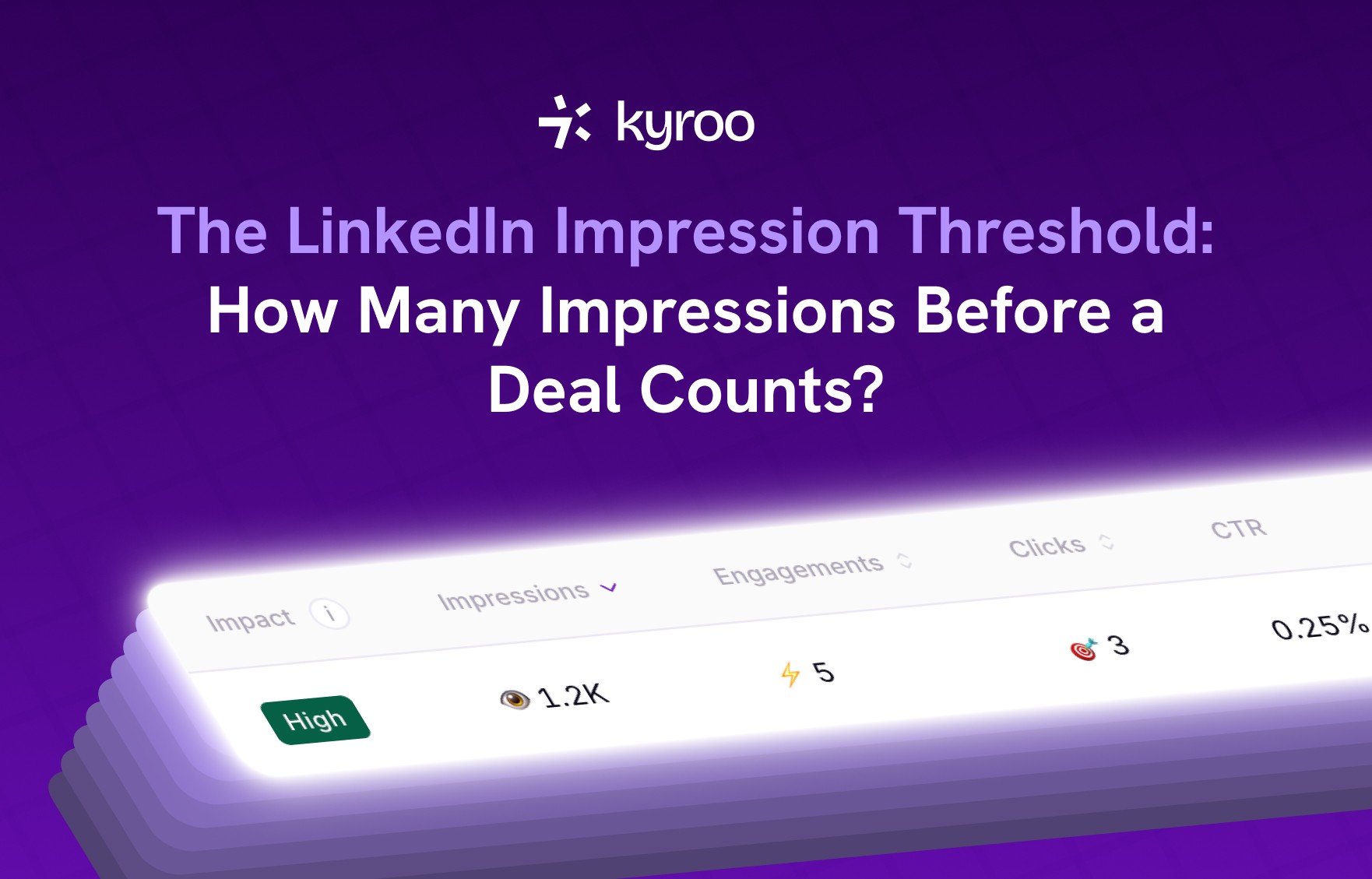
The LinkedIn Impression Threshold: How Many Impressions Before a Deal Counts?
What's the right number of LinkedIn impressions before a deal counts as influenced? A practical guide to setting your attribution threshold and lookback window for B2B SaaS.
If you've ever tried to attribute LinkedIn ads to your pipeline, you've run into this question whether you realised it or not.
A company saw your ad once. Are they influenced?
What about three times? Eight times? Twenty?
This is the impression threshold question, and how you answer it determines whether your attribution data is meaningful or noise. Most attribution tools either pick a number for you and don't explain why, or they ignore the question entirely and count any impression as influence. Both approaches are wrong.
This post explains what the impression threshold is, why it matters, and how to set yours.
Why a Single Impression Doesn't Mean a Deal Is Influenced
The instinct in B2B marketing is to count everything. If a company in your pipeline shows up in your LinkedIn impression data even once, count them as influenced. Your influenced pipeline number goes up. Your CEO is happy. Everyone wins.
The problem is that a single impression is statistical noise. LinkedIn shows your ads to a wide audience. A junior hire at your target account scrolling LinkedIn at lunch and glancing past your ad for half a second is not the same thing as a senior decision-maker at that account seeing your ad fourteen times across two months as your campaigns build familiarity with your brand.
If you count the first one as influence, your data lies to you. Your reports show pipeline impact that isn't real. The number that gets sent to your CEO is inflated. When the campaigns get cut and the influenced pipeline doesn't disappear, it becomes obvious the attribution wasn't measuring anything in the first place.
Real influence requires repeated exposure. The whole point of LinkedIn ads in B2B is the slow build of brand recognition over time. A buyer who sees your ad once and forgets it the next day isn't influenced by it. A buyer who sees your ad fourteen times across two months while comparing your category against your competitors is. One impression doesn't build that recognition. Eight do. Twenty do better.
What the Impression Threshold Actually Is
The impression threshold is the minimum number of times a company needs to see your ads before that company counts as influenced.
It's just a number. Five impressions. Eight. Fifteen. Whatever you set.
A company that hits the threshold is influenced. A company that doesn't, isn't. Deals at influenced companies count toward your influenced pipeline. Deals at companies below the threshold don't.
This is the difference between attribution that means something and attribution that's just a vanity number.
The Default Threshold and Where It Comes From
Kyroo's default LinkedIn impression threshold is 8 impressions. This isn't arbitrary.
The number comes from a few places. The marketing research literature on brand recognition consistently lands somewhere between 7 and 12 exposures before a brand becomes mentally available. The classic "Rule of 7" in advertising is older than LinkedIn but still holds up reasonably well for B2B. Studies by LinkedIn's own B2B Institute and the Ehrenberg-Bass Institute place the threshold for meaningful exposure in the 6-10 range for most B2B categories.
Eight is the middle of that range. It's also a number that produces useful attribution data in practice. Set the threshold too low and your influenced pipeline includes everyone, which makes it meaningless. Set it too high and you exclude real influence and your numbers look artificially small.
Eight, in the data we've seen, is the number that separates noise from signal cleanly for most B2B SaaS companies.
When You Should Adjust the Threshold
Eight is a sensible default but it's not the right answer for every team. Here are the situations where you'd raise or lower it.
Lower the threshold (3-5 impressions) if:
Your sales cycle is short. If your average deal closes in 14-30 days, there isn't time for a company to accumulate 8 impressions before they buy. A lower threshold captures real influence in fast cycles.
You're running a small budget. If you're spending less than £2,000 a month on LinkedIn, you may not generate enough impressions per company to consistently hit 8. A lower threshold prevents you from undercounting genuine influence.
You're targeting a tight ICP. If you're advertising to 200 named accounts rather than a broad function-and-seniority audience, every impression carries more weight. Each impression is at a buyer, not a random scroller. Lower threshold, same signal quality.
Raise the threshold (12-20 impressions) if:
Your sales cycle is long. Enterprise B2B with 6-12 month cycles gives plenty of time for impressions to accumulate. Setting the threshold higher filters out drive-by exposure and only counts genuine repeated targeting.
You're running large budgets. If you're spending £20,000+ a month on LinkedIn, your impressions-per-company number is high enough that 8 might not be meaningful anymore. A higher threshold separates the companies you're actually working from the broader audience you're reaching.
You're running broad targeting. If your LinkedIn audience is large and unfiltered, you'll generate impressions against companies that aren't really your ICP. A higher threshold filters those out and leaves only the companies you're hitting hard.
How to Calibrate Your Threshold
You don't need to guess. You can calibrate the threshold against your own data once you have a few months of attribution running.
The simplest calibration is to look at your Closed Won deals from the last 6-12 months. For each one, look at the impression count of the company before the deal closed. Take the median.
If the median is 14 impressions, your threshold should probably be somewhere between 8 and 12. Companies at that exposure level are converting, so that's the level that matters.
If the median is 4 impressions, your threshold should be lower. Your customers are buying with relatively light brand exposure. Don't filter them out by setting the threshold too high.
You can also look at the inverse. Take the open deals in your pipeline that aren't moving, and look at their impression counts. If they're at 25 impressions and not converting, your threshold isn't the problem. The targeting is, or the messaging is, or the product fit is.
This is the kind of analysis that's almost impossible to do without proper attribution infrastructure. It's also the analysis that turns LinkedIn from a faith-based channel into a measurable one.
Why This Is the Most Important Setting in Your Attribution Stack
Most attribution tools hide this from you. They pick a number, don't tell you what it is, and present the resulting influenced pipeline as a fact. This is bad practice. The threshold is the single biggest assumption in your attribution model. It deserves to be visible, configurable, and defended with reasoning.
If your attribution provider can't tell you what their threshold is, or won't let you change it, you're not getting attribution. You're getting a number with their assumptions baked in, and you have no way to validate whether those assumptions match your business.
Kyroo exposes the threshold in your attribution settings as a slider. You can change it, see the impact on your influenced pipeline number in real time, and pick the value that matches your sales cycle and budget. This isn't a feature. It's just how attribution should work.
A Realistic Example
Say you're a B2B SaaS company spending £6,000 a month on LinkedIn Ads against a 400-company target list. Your average deal cycle is 60 days. You have 35 open deals in HubSpot worth £520,000.
With a default threshold of 8 impressions, your attribution shows 22 of your 35 open deals are at influenced companies. Influenced pipeline: £340,000. Pipeline ROI: 56x.
Lower the threshold to 5 impressions: 28 of your 35 deals become influenced. Pipeline goes to £420,000. ROI looks even better at 70x. But are those extra 6 deals actually influenced, or are you counting noise?
Raise the threshold to 12 impressions: 14 of 35 deals become influenced. Pipeline drops to £215,000. ROI: 36x. Now you might be undercounting real influence at the lower end of the impression scale.
The right answer is somewhere in this range, and you can calibrate it against your historical Closed Won data. There is no universal correct number, but there is a correct number for your business. The point of a configurable threshold is that you can find it.
How to Set Your Impression Threshold in Kyroo
If you're already a Kyroo user, you can adjust your threshold in two clicks:
Click on your Company in the sidebar, then find "Attribution model"
Adjust the LinkedIn Impression Threshold by selecting a preset, or typing in a custom value.
Hit save, and you're all set!
Your influenced pipeline number recalculates immediately based on the new setting. You can experiment with different values to see how they affect your attribution data.
If you're not yet a Kyroo user, you can sign up for a free 30-day trial at app.getkyroo.com, connect your LinkedIn Ads and HubSpot accounts, and have your first attribution report ready the same day. The setup takes under 2 minutes and no credit card is required.
FAQ
Why is the default 8 impressions and not 5 or 10?
8 sits in the middle of the research range for B2B brand recognition (typically 6-10 exposures before mental availability) and produces useful attribution data in practice for most B2B SaaS companies. It's a starting point, not a fixed answer.
What about clicks? Should clicks count differently?
A click is more meaningful than an impression but Kyroo's threshold is impression-based by default because most LinkedIn engagement is impression-driven, not click-driven. The buyer who clicks once and converts is a different signal than the buyer who sees your ad fifteen times and recognises your brand when your sales rep emails them. Both matter; the threshold focuses on the second pattern because it's the more common B2B path. In Kyroo, clicks also do impact the influence score that your deals get - so clicks aren't ignored.
Can the threshold be different for different campaigns?
Not currently. The threshold applies across your whole LinkedIn account. This is intentional: attribution at the company level should be consistent regardless of which campaign reached them. Per-campaign thresholds risk gaming the data to make individual campaigns look better than they are.
One platform.
Full visibility.
Your ad spend, connected
Kyroo pulls every campaign, every company reached, every impression, and every engagement.

Your pipeline, explained
Kyroo joins your ad data to your pipeline so you know which campaigns influenced which revenue.

Your team, always in the loop
Real-time alerts in the channels your team already uses. Know when a target account heats up the moment it happens.